

Backlinks are essential for a good SEO strategy, as they can significantly impact your SEO ranking.
Make sure you consider the following 7 tips when optimizing your backlinks.

What are Backlinks?
Backlinks are links from other websites that lead to your website. They are directly related to SEO.
The better the reputation of the site linking to yours, the more valuable the recommendation is, and the more positively it influences your website's SEO ranking. Additionally, a high domain popularity (the number of pages linking to your own site) is important.
Google works like people do: the more important the person giving the recommendation, the more seriously we take it. Similarly, we consider a recommendation from a hundred different people more relevant than a hundred recommendations from the same person.
These links not only signal to search engines how important your website is, but they are also helpful for users and generate traffic (clicks) to your site.
Thus, a good backlink strategy supports your SEO strategy and strengthens your website overall.
🔗 1/ Competitor Analysis
Discover your current position and identify your competitors.
Using tools like SEMrush or suite.searchmetrics.com, you can determine who your competitors are and how many visitors your website receives.
Compare yourself with the competition and look to the companies that appear at the top of search engines for your keywords – because that's where you want to be.
If you are in first place here, then CONGRATULATIONS: You already have a good backlink strategy and probably don't need any further optimization. 😉
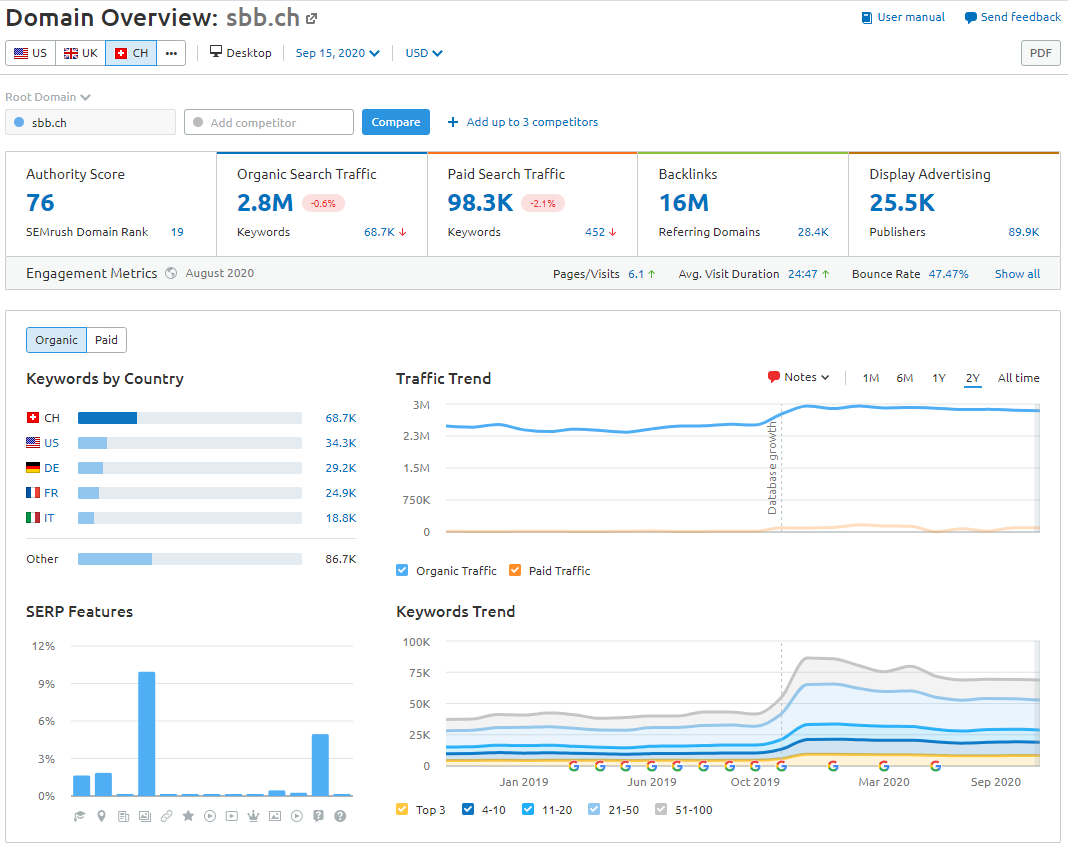
SEMrush Analysis of www.sbb.ch
Tools like linkody.com or SEMrush assess the quality of your existing backlinks. It's also crucial to compare your backlink profile with that of your competitors.

SEMrush Backlink Analysis of www.sbb.ch

What Does SEO Mean?
SEO stands for 'Search Engine Optimization'.
The aim is for search engines like Google and Bing to position your website as high as possible in their results. This allows you to generate clicks to your site when users make relevant search queries – a crucial step that is often forgotten.
This is achieved through various optimization techniques. Unlike Google Ads, the clicks generated after these optimizations are free.
🔗 2/ What Makes Good Backlinks?
For effective backlinks, both quality and appropriate frequency are key. Remember, less can often be more, because if the quality of the linking websites is poor, it can negatively impact your own site's ranking.
Let's take a look at the offline world:
Imagine a friend, in his mid-60s, single, an insurance agent with no children, recommending a new baby food product to you. Does that sound credible? Of course not. Google applies the same logic to backlinks. That's why it's essential: Backlinks must be placed thoughtfully, on pages that are as relevant as possible. Google is quick to detect when a link has been added purely for SEO purposes.
Relevance is assessed based on various factors.
👉 Content of the linking domain
👉 Quality of the backlinks
👉 Topical relevance of the content
The most effective are content links, which are links embedded within the main body of text. These can be seamlessly integrated using anchor text that clearly describes the linked page.
For instance, an article recommendation can be linked using anchor text like this: Online Marketing Trends for SMEs 2020. Search engines positively evaluate websites that are linked in a natural and organic manner.
Be cautious of «trash links» from press portals, directories, or comment sections, as these are ineffective and can even harm your site.
As a general rule: the easier a link is to create, such as through a comment, the less value it holds for SEO ranking.
Conversely, the more challenging a link is to acquire, such as editorial links from a reputable newspaper, the more value it carries. These editorial links should always be contextually relevant. For instance, if a clothing store is linked in a car magazine, it lacks topical relevance and will not be effective.
🔗 3/ Consider Link Juice
It is beneficial if on your page other relevant pages are linked. Finding a healthy balance is key to success here. This is because if too many other pages are linked, you will have to share the so-called Link-Juice with those pages.
Link-Juice refers to the qualities and relevance that a page passes on to the pages it links to.
Your page can lose credibility if Google considers it inauthentic due to too many links. The placement of links on the page is also important. The fewer clicks it takes to get from the homepage to the linked page, the more valuable the backlink. Links in the footer or sidebar are less effective.

🔗 4/ The Importance of DoFollow and NoFollow Links
It's important to understand the difference between DoFollow and NoFollow links.
DoFollow links are heavily considered by search engines for ranking, while NoFollow links are given little or no consideration.
When all links were DoFollow links, there was a lot of spam and irrelevant linking. Today, a link can be coded with "rel=nofollow" to separate its ranking power.
NoFollow links primarily influence search engines indirectly by generating additional traffic, which in turn has a positive impact on SEO.
There are also opinions that NoFollow links now directly influence SEO again, but extensive studies on this are still lacking.

On-page and Off-page Optimizations
SEO is divided into Off-page and On-page Optimizations. As the name suggests, On-page Optimization involves improvements made directly on your own website. When the website is improved, both users and search engines rate the page better, which consequently leads to a higher position and additional clicks from searchers.
Off-page Optimization represents the second subgroup within SEO. Off-page focuses on optimizations that do NOT take place on your own website. Backlink building is a central component of this.
🔗 5/ Suitable Backlink Pages
Use competitor analysis to find pages that are suitable for backlinks. When doing so, you should ensure that you only adopt good backlinks – after all, you don't want to rank just as well, but better.
With various tools, you can enter relevant keywords and receive a list of the Top 100 Websites currently ranking for your keywords. If you can place your link on these pages, you will also benefit from their Link-Juice.
The easiest backlinks to create are links in your own email footer, in job postings, and on platforms like Bing Places or Google My Business.
🔗 6/ Backlink Sources
You know where you want to link your page, but are you wondering how to get these links? Generally, building good backlinks requires an investment of time and often money.
The most effective way is to contact the website owners with an explanation of why they should link to your page.
It is important that you provide good content – keyword Content Marketing. Often, website operators will want something in return in the form of financial compensation, which can range from CHF 100 to several thousand Swiss Francs.
The amount of this compensation depends on the industry and the quality of the page. With so-called Affiliate Partnerships with bloggers, the amount of compensation per click via the placed link can be regulated.
Additionally, the websites of your business partners, clients, and suppliers can also serve as valuable sources for backlinks.
The same principle applies to pages belonging to your friends, acquaintances, and relatives, as long as the link is thematically relevant.

🔗 7/ Removing Bad Backlinks
When building links, it's crucial to avoid Google Penalties. These penalties are issued when Google detects that backlinks were artificially created, or if the linking pages are of poor quality or considered spam. Such penalties can significantly devalue your website.
While SEMrush and similar tools can help identify poor links, removing all of them is often nearly impossible because the website owners are frequently unknown.
Although Google allows you to disavow bad links, this feature should be used with extreme caution. Incorrect application can have negative consequences for your SEO.
Furthermore, Google is usually 'smart' enough to filter out these untrustworthy links on its own. Ultimately, Google aims to provide users with the most relevant search results possible.
Conclusion
Google, Bing, and other search engines are in a constant state of change, continuously adapting their SEO algorithms.
Consequently, your backlink and SEO strategy must also be continuously adapted.
Building backlinks is a long-term, continuous process that cannot be completed overnight. It requires a well-defined strategy, including competitive analysis and regular adjustments based on new insights.
Backlinks alone are not enough for successful SEO. A comprehensive SEO strategy is essential, encompassing both OnPage and OffPage optimization.
Do you have any questions or feedback? Please share them in the comments. For professional SEO agency services, feel free to contact onlineKarma.