
Are you as digital as the future?
By 2020, more people will own a smartphone than have access to running water or electricity*. This is dramatic and also shows the scale of digitalisation.
Digitalisation is also fundamentally changing the marketing world. Companies must adapt their strategies to the online world if they want to remain viable in the long term.
Especially for younger generations—Millennials (Generation Y) and Generation Z (born 2000 to 2015)—social media plays a fundamental role in purchase decisions even today.
These changes present major challenges for companies. However, they also offer a unique opportunity to stand out successfully in the market.

Convenience matters more than price
New findings show that for most customers, convenience and brand loyalty are more relevant than price when making a purchase decision. Companies can use this understanding of new market conditions to their advantage. If you offer customers a unique customer experience, it is very likely that they will remain customers of your company in the long term—regardless of price.
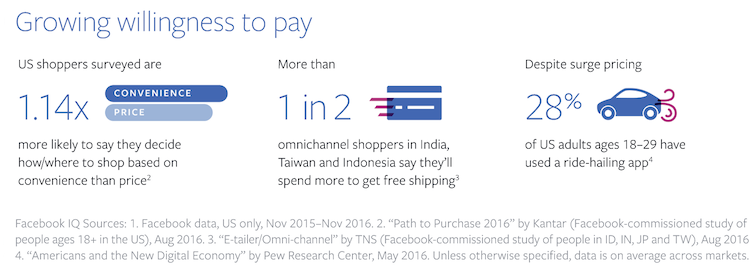
According to a recent Facebook IQ study, convenience is twice as important as price to customers when shopping. Brands such as Nivea manage to retain and delight consumers over the long term and across different life stages thanks to a distinctive product design.
As a result, the price of products and services is becoming less and less important due to digitalisation. If a customer sees a shoe in a store, they can immediately use their smartphone to check whether the shoe is cheaper online or in another store. The same naturally applies to e-commerce. A customer who is only interested in price will find the cheapest shoe anyway.

Can your customers reach you easily enough?
Digitalisation is making customers increasingly demanding. “immediacy” and “convenience” are essential to win customers over. First and foremost, this means reaching customers where they already are: on social media—through brand pages, contact options and customer communities. In addition, you need customer service that responds quickly and easily to customer needs.
Long phone calls and endless email back-and-forth are driving customers away more and more. According to a Salesforce study, 89% of customers will not make a second purchase if they are dissatisfied with a company’s customer service. More than 50% of customers are also happy to pay more if the customer service is satisfactory.

Understand your customers.
Companies that want to remain competitive today and in the future must understand one thing: the customer is at the centre. All corporate strategies must be aligned with the customer. Otherwise, in a digital world it is not possible to retain customers in the long term. They will make their purchase from another company that understands their expectations. Companies will therefore need to embrace two concepts more and more: user experience and customer experience.
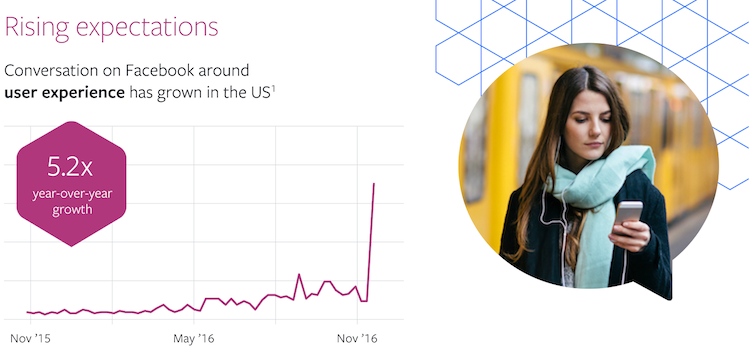
User Experience (UX) – Provide the best possible user experience
User Experience (UX) is first and foremost about understanding the customer and their needs. You then work to create products and services that meet these needs and delight the customer.
UX plays a central role for all websites, apps and programs. Before creating a website, for example, you need to understand how you want the customer to navigate, how the customer wants to move through the site, what content they want, and what design appeals to them. Too often, customers visit a website without taking action or completing a purchase. This is usually due to poor user experience.
Customers are increasingly less satisfied with websites that have poor usability or an unimaginative design. Bank of America reports that it recorded 45% more registrations on its website after it implemented UX guidelines in its portal.
Not thinking about UX is a luxury companies can no longer afford—even today. In the future, poor UX will very likely put some companies out of business.

Customer Experience (CX) – Create a positive customer experience
Customer Experience (CX) could be described as UX’s big sister. CX is about every experience a customer has when dealing with a company.
CX covers the entire product life cycle and all touchpoints between companies and customers. Here too, customer service plays an important role in preventing negative experiences. Social media must not be overlooked either. Customers are increasingly reading customer reviews on social media and letting other people’s experiences influence their purchase decisions. Customers who have a negative CX often vent their frustration on social media. That is why professional social media management is essential.

More connected than ever
The market research firm Gartner estimates that by 2020 there will be 20.8 billion connected devices worldwide. Each of these devices offers companies an opportunity to interact with customers or potential customers. But you need to know how—especially in marketing. You also need to act quickly to channel this potential before your competitors do.

Use cross-device marketing
Google reports that nine out of ten customers already switch between different digital devices before making a purchase. This knowledge can help companies improve their conversion rate (CTR). Conversion rate refers to the ratio between website visitors and completed purchases or transactions. The resulting figure is considered an important metric for checking the effectiveness of your marketing.
Companies have been able to demonstrate that their conversion rate improved as soon as they took cross-device marketing into account. Shutterfly, an American photo technology company, was able to increase its conversion rate by more than 15%, for example. Cross-device marketing means finding the right advertising asset for the right user across different digital devices. Users are increasingly switching between devices such as smartphones, tablets or laptops. They research their purchase on one device, but then often complete the purchase on another.
In its latest report on cross-device commerce, Criteo, a performance marketing platform, reports that 31% of consumers use more than one device before completing a transaction.