Why aren’t more people supporting your nonprofit organization? What are you doing wrong? Perhaps you’re neglecting online fundraising and its proven best practices.
We’ll show you 7 common mistakes in online fundraising and how you can avoid them—so you can inspire and attract more donors online in 2020.


The Basics of Online Fundraising
Online fundraising isn’t exactly new, but it’s becoming more popular and successful every year. While the so-called new payment channels still account for only a small portion of total donations, their growth has been remarkable. Between 2013 and 2018, the volume of online donations in Switzerland grew by more than 150% (ZEWO Donation Statistics).
So it’s time for you to learn the best practices of online fundraising and avoid the mistakes that drive away potential online donors.
The first step toward successful digital fundraising is developing a process that allows supporters to donate online. We recommend that this take place directly on your website rather than through a redirect to another page.
In addition to this donation form on your website, online fundraising includes all digital channels you use to direct people to your form and encourage them to make a donation. This includes, for example, all content containing calls to donate on your website, in your emails, and on your social media channels.
There are a few things that can go wrong when you ask people online for donations. We’ve compiled a list of the 7 most serious mistakes for you here.
⚠️ Mistake #1: Donating on your website is too complicated
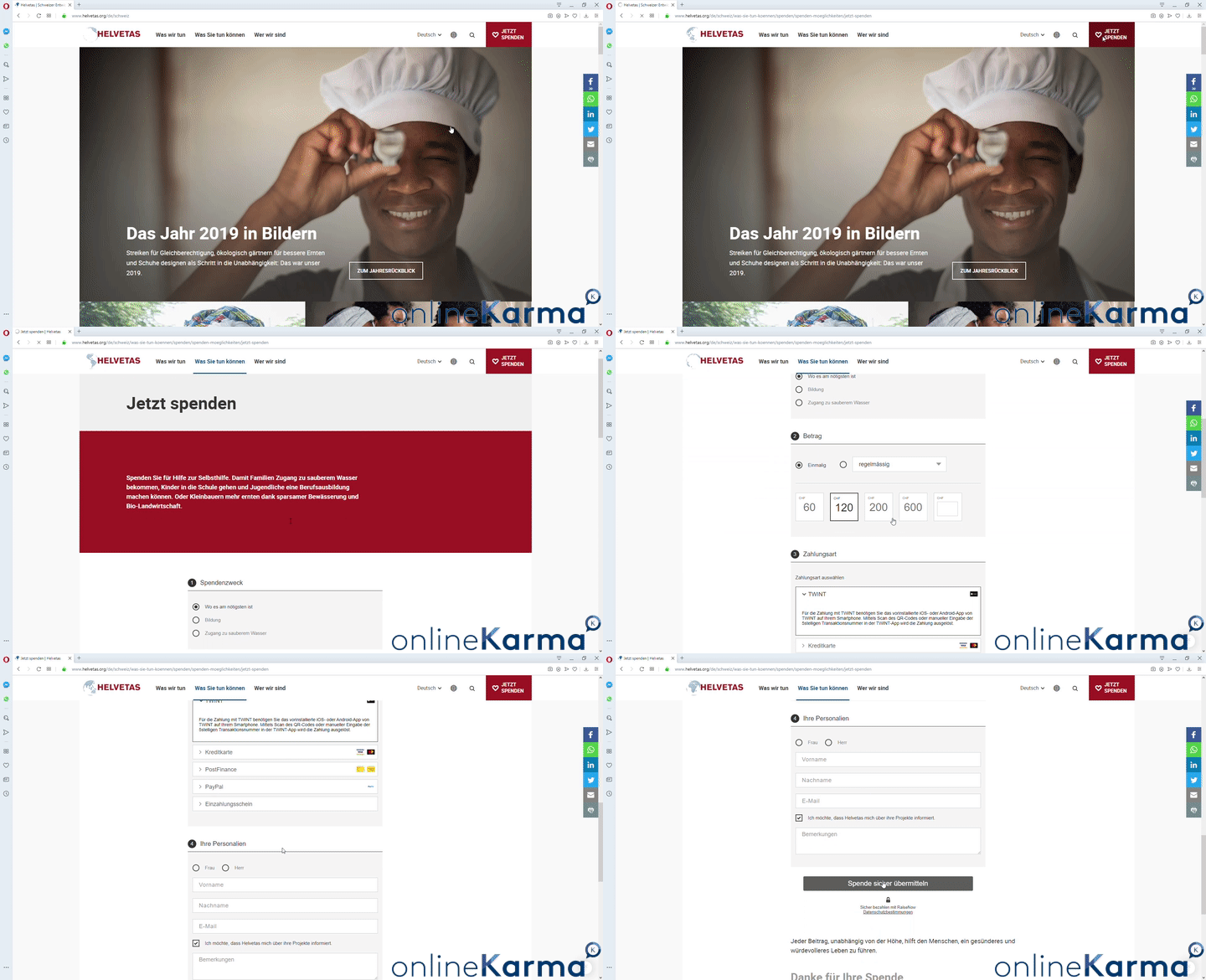
Go to your website yourself and walk through the process that a potential donor must go through if they want to donate to you online. How long does it take? Are there any steps along the way that are confusing or frustrating for someone doing this for the first time?
Perhaps you have multiple donation forms in circulation, broken links to your donation page, a confusing array of donation options, or people have to struggle through a six-page form before they can actually make a donation.

Your donation page should have only one call to action, and that should be a call to donate.
Additional calls to action, links to other pages, and walls of text that push the donation form down the page are unnecessary obstacles and distractions for donors.
You should also avoid redirecting donors to another website to make a donation. In addition to building greater trust among donors (since they remain on your website), this has the advantage of allowing your website to provide donors with further information and contact options.
⚠️ Mistake #2: You don't know your donors well enough
Personalization is important, especially for donors. Learning more about exactly who donates to your organization helps you in two ways:
First, this will make your existing donors happy, encouraging them to continue donating. And second, it will inspire similar people to support your cause as well.
We all know how important building relationships is for fundraising.
And these relationships begin with getting to know your donors better.

Do you have personas for your different donors? And have you ever mapped out the journey that donors typically take—from first learning about your organization to making their first donation?
⚠️ Mistake #3: You use the same message for everyone
If you get to know your donors better, you can increase your retention rate and, above all, produce more relevant content for your online fundraising channels. Because:
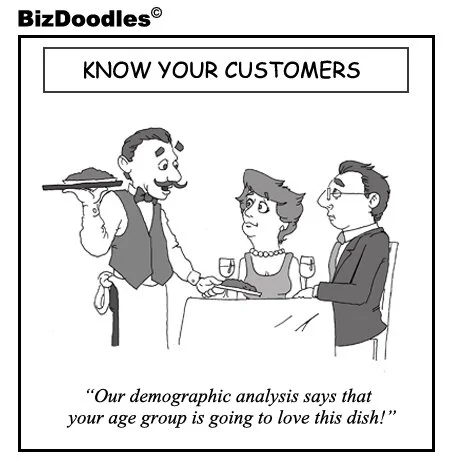
Not all of your donors are the same, so they shouldn’t all receive the same message.
Imagine being able to write content tailored to a specific person in order to persuade them to do something. That’s much easier than getting the “general public” to support your organization in various ways.
One of the best and easiest ways to segment is through email marketing.
Email is still the best way to reach donors.
But you need to take a strategic approach to deciding who to send it to and how to address each group.
People who have been donating for years and are familiar with your organization’s history and processes shouldn’t receive the same messages as a first-time donor, who may not be quite as familiar with everything you do.
⚠️ Mistake #4: You don't say thank you properly
After an online donation is made, it is customary to redirect donors to a thank-you page and send them an email with a donation receipt and a brief thank-you note.
If you aren’t doing that yet, start today!
You can also automate this process to minimize the workload for your team and prevent errors.

Once this basic step is complete, the next phase of expressing gratitude begins. For example, you should inform donors—to a reasonable extent—about the impact of their donation and send them updates. This also increases the likelihood that they will donate again or even become regular donors.
⚠️ Mistake #5: You're not building a real relationship
Mistake #1 was about making it as easy as possible for users to donate. However, that doesn’t mean that, as a fundraiser, you should focus solely on asking for donations.
Donors give only out of conviction, and it’s up to you to lay the groundwork.
To do this, make use of the content on your website, blog, social media channels, and in your newsletter. This will help you build and maintain a relationship so that your donors are as well-informed as possible about you and your cause—and are then ready to donate.

Tell a short and compelling story that shows who you are, informs people about your mission, and builds trust in your organization and the important work you do.
A picture really is worth a thousand words.
Choose a meaningful photo that supports your story so your content doesn’t become too text-heavy.
⚠️ Mistake #6: You don't show the impact of donations enough
Your donors want to know, before they donate, how their money will be used and what impact it will have.
That is why, when appealing for donations, it is important to show how every single donation can make a difference in a person’s life.
To do this, you can use testimonials and statistics about your work. Ideally, you should also have an “Impact” page on your website where all your impact stories, images, and data are collected and easily accessible.
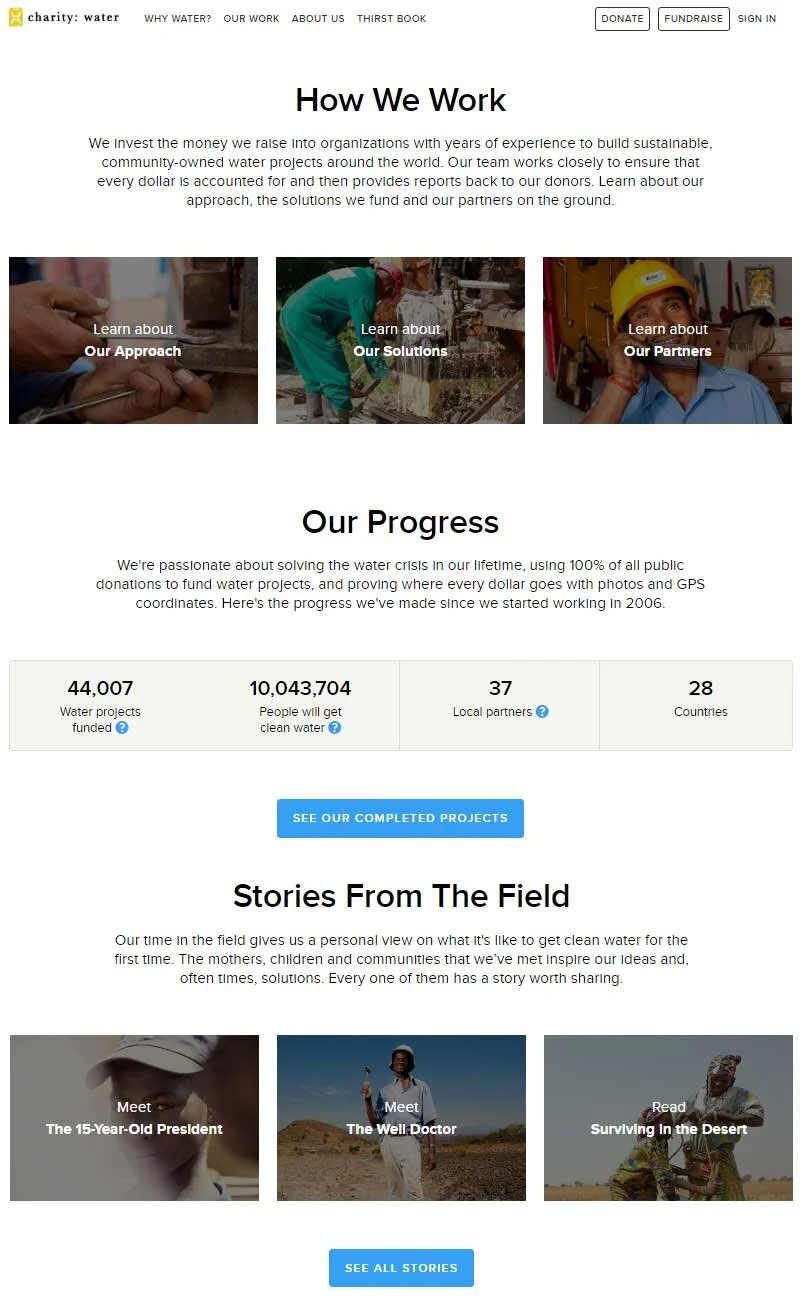
Potential donors see this landing page when they search for examples of your organization’s work and achievements, and want to know exactly how you bring your mission to life.
Be sure to include a call to donate on this page that directs people straight to your donation form.
⚠️ Mistake #7: Online and digital aren't part of your fundraising strategy
It’s always good to have a clear strategy. It helps us achieve more of our goals and prioritize the projects that matter most. When it comes to fundraising, a strategy can mean the difference between success and complete frustration.
Setting goals is the first step in developing a fundraising strategy.
They provide motivation, insights, and a concrete goal to strive for throughout the entire process.

Unfortunately, online and digital fundraising is often neglected or even completely overlooked in strategic planning.
Once the decision has been made internally to engage in online fundraising, several questions arise that must be addressed in an online strategy or digital concept, such as:
-
Who is responsible?
-
What type of online fundraising do you want to do?
-
Is the website ready in terms of both technology and content?
-
Is there a newsletter?
-
Have you selected the relevant social media channels?
-
Are you planning campaigns using Google Ads or Google Grants?
-
Has donor management been addressed?
-
How do you plan to measure success?
It’s clear that this can’t happen overnight. But having a strategy for your online fundraising is crucial to your success.

What is Google Grants?
Google Grants is the nonprofit version of Google Ads, Google’s online advertising tool. It enables nonprofit organizations to promote their missions and initiatives on Google by providing them with a monthly advertising budget of $10,000. Google Grants is offered through Google for Nonprofits.
Eligible organizations can apply online for Google Grants. Google typically processes the application within a week. Once the application is approved, the organization is responsible for managing the Google Grants account, including all campaigns, ad groups, and keywords.
The use of Google Grants is subject to certain rules and restrictions that every organization must follow. Violations of these rules will result in the account being suspended.
➖ Each account requires geographic targeting
➖ At least two active ad groups per campaign and two sitelink extensions
➖ Each account must achieve a click-through rate (CTR) of at least 5% every month
➖ Each account must have conversion tracking set up
➖ Every campaign must use conversion-based smart bidding
Conclusion
You may be making some of these mistakes in online fundraising—or perhaps even all of them.
You’re not alone in that.
Correcting these common mistakes will put you and your organization on the right track to raising more donations online and significantly improving the experience for your donors.
Implementing Professional Online Fundraising